
Chicago HOA Fees: The Cost of the Ride—And What Too Many People Get Wrong
Read Time: ~5 minutes
Few topics in Chicago real estate generate more noise than HOA fees. After nearly 30 years in this business—across every major neighborhood, every type of building—I can tell you this: most of the loudest opinions come from people who have never actually operated inside a building budget. It’s the same scene we’ve all seen—someone successful in their own field, usually the parent, standing at an inspection, second-guessing the inspector, the contractor, and the builder. You hear it. You know it’s wrong. And you move on. But when it comes to HOA fees, it’s worth getting this right.
They’re Not Arbitrary
Assessments aren’t random. They’re built from what it costs to operate the building, what it takes to maintain it, and what must be reserved for the future, divided across ownership. That’s it.
What’s “normal” in Chicago right now depends entirely on the asset class. Luxury high-rises are sitting at $1,500 to $4,000+, while standard downtown buildings range from $400 to $1,000. In the neighborhoods, condos run between $250 and $600, while vintage walk-ups command $200 to $400. Different buildings, different lifestyles, and entirely different cost structures.
The Reality: We’re in a Reset
Chicago’s condo market is going through a financial reckoning. Insurance is now a major cost driver, labor continues to rise, and materials and capital projects are more expensive. Layered on top of that, years of deferred maintenance are catching up. For a long time, some buildings kept fees artificially low. Now they’re paying for it.
The 2025–2026 market is a true pivot point. Catch-up budgets are hitting, insurance increases of 10–15%+ are common, and major projects are unavoidable. At the same time, operating costs are rising faster than property values. That gap doesn’t disappear; it shows up in assessments.
Where buyers may get it wrong is focusing solely on the lower number. Everyone loves a low HOA fee until they understand what it actually means. Because often, it means underfunded reserves, deferred maintenance, and a future special assessment. Low today can be expensive tomorrow.
Special assessments usually come down to four things: facades, roofs, elevators, and life-safety/code upgrades. These aren’t optional. And today, there’s another layer: if a building has significant unfunded repairs—often $10K+ per unit—financing can become an issue overnight. Insurance has changed the conversation entirely. In some buildings, premiums have jumped dramatically in a single year. And remember, the building covers the structure; you still need your own “studs-in” coverage for everything inside your unit.
The Metric Most People Miss: Price Per Square Foot
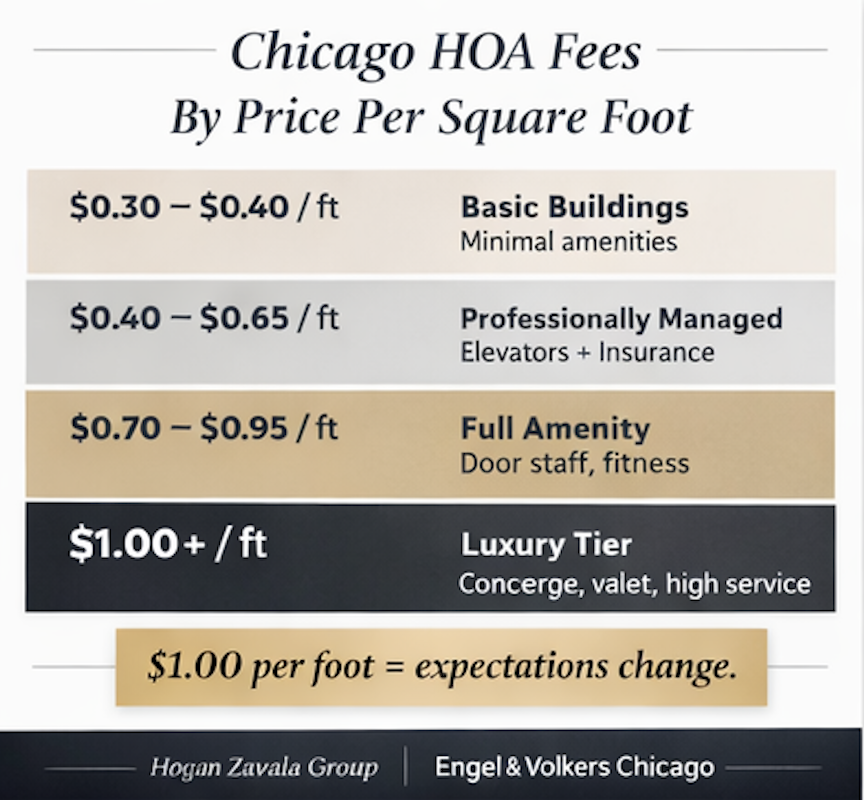
Over time, you start to see patterns. One of the most useful benchmarks is evaluating what you are paying per square foot in the assessment. It removes the noise and shows you how the building is actually operating.
-
$0.30 – $0.40 / ft → Basic, stable, no-frills
-
$0.40 – $0.65 / ft → Professionally managed
-
$0.70 – $0.95 / ft → Full-amenity
-
$1.00+ / ft → Upper-tier, high-service
The $1.00 line is where expectations change. If you’re paying $1.00 per foot, you should be getting a true full-service experience. If not—that’s not normal.
Why this matters now is that even the “normal” ranges are moving. Insurance alone can shift a building from $0.35 to $0.45, labor costs are rising, and reserve studies are exposing underfunding. What used to be average is adjusting—fast. A pro insight to consider: compare the assessment price per square foot versus the property value per square foot. If fees are rising while values are flat or declining, that’s not just a number issue. That’s a building positioning problem.
The Moment That Matters Most: Attorney Review
This is where the real story shows up. The Section 22.1 disclosure reveals reserve balances, upcoming assessments, litigation, and delinquency. This is where experience matters most, because every building has something.
What we actually look for when analyzing these documents comes down to a few critical, real-world questions: Are reserves being funded—or avoided? Are repairs planned—or ignored? Is there a current reserve study? Are owners paying—or falling behind? What’s coming that hasn’t been voted on yet? Is litigation routine—or a problem? Is the building stable—or investor-heavy?
This is where deals are either confirmed or quietly fall apart. Where this is heading is toward more reserve transparency, more consistent planning, and more informed buyers. And that’s a good thing.
What You’re Really Paying For
A lot is being said right now about HOA fees. Some of it is accurate, and some of it isn’t. Here’s how I’ve always looked at it: assessments are the cost of the ride. If you want a well-run building, strong reserves, professional management, and long-term stability, there’s a price for that. The goal isn’t to avoid it; the goal is to understand it and make the right call.
At the upper end of the market, this isn’t just about a building. It’s about how life works inside it. Dog runs, on-site engineers, pools, door staff, and event rooms that rival the best available. You are paying for package handling, security, and true lock-and-leave living. At a certain level, these buildings stop behaving like residences. They start behaving like resorts.
For many buyers, that’s the point. At the highest level, you’re not paying for a unit—you’re paying for a lifestyle that runs without friction. If you’re looking at condos in Chicago right now, this is where experience matters. Happy to walk through a building with you—and tell you what’s real, what’s noise, and what’s coming next.
You may also be interested in:- Chicago Property Taxes Explained
- Chicago Closing Costs Guide
- Gold Coast Neighborhood Page
- Streeterville Neighborhood Page
- Lincoln Park Neighborhood Page
— Craig Hogan & Rudy Zavala
Hogan Zavala Group | Engel & Völkers Chicago
Details on the top 10 markets in Chicago are just a click away!
Categories
- All Blogs (130)
- Adaptive Reuse (2)
- Architecturally Significant (23)
- Architecture (59)
- Art (2)
- Art Collecting (2)
- Bespoke Lighting (2)
- Buena Park (1)
- buyer strategy (30)
- Career Moves (9)
- chandeliers, (1)
- Chicago HOA Fees (7)
- Chicago Luxury Real Estate (94)
- Chicago Property Taxes (4)
- closet design (2)
- Co-Ownership (3)
- Coffee (1)
- Condo Assessments (7)
- coop apartments (5)
- cooperative apartments (8)
- custom closet advice (1)
- Days on Market (16)
- Design (51)
- Fulton Market District (8)
- Gold Coast (25)
- Golden Visa Programs (10)
- Historic Homes (8)
- Hogan Zavala Group (60)
- Holiday Abroad (1)
- International Citizenship (15)
- International Real Estate (31)
- Kitchen Design (13)
- Lakeview (14)
- Legacy (3)
- LGBTQ Housing (2)
- LGBTQ+ (4)
- Lifestyle (78)
- Lighting (2)
- Lincoln Park (14)
- Loft Living (5)
- Lofts (5)
- Logan Square (4)
- loneliness & aging (2)
- Loop (2)
- Luxury Market Index (4)
- Marina Towers (4)
- Market Insights (17)
- Market Update (36)
- Mid Century (2)
- New East Side (1)
- Outdoors (5)
- Pacaso Vacation Homes (3)
- pied-à-terre (15)
- Puerto Vallarta (8)
- Puerto Vallarta Real Estate (9)
- Real Estate Agents Success (11)
- Real Estate Industry (30)
- Real Estate Legal Changes (5)
- Real Estate Transactions (7)
- ritual (4)
- River North (21)
- River West (14)
- Second Homes (9)
- Seller Strategy (28)
- Selling and Buying in Chicago (34)
- Senior Housing (2)
- Streeterville (15)
- Summer (7)
- Sustainability (7)
- Taxes (5)
- Thanksgiving Travel (1)
- The 606 (1)
- The Henrys (1)
- Travel (1)
- Trends (29)
- Trifecta (17)
- Uptown (2)
- video (1)
- video for real estate (2)
- Wellness (9)
- West Loop (9)
- Wheaton (1)
- Wicker Park | Bucktown (4)
- Wines for Summer (2)
Recent Posts








Craig Hogan | Rudy Zavala