
The New Architectural Pedigree: A Building's Balance Sheet
The End of Cheap Condo Assessments: How Fannie Mae's 2026–2027 Guidelines Reset Chicago Equity
Word Count 682 | Read Time 3 minutes,
The financial anatomy of the Chicago condominium market is undergoing a fundamental rewrite. Lenders are quietly sorting properties into two distinct categories: those that remain viable for conventional financing, and those that are rapidly becoming distressed assets requiring heavy structural support and intense underwriting review.
When Illinois Realtors Legal Hotline Attorney Vicki Munson broke down the updated Fannie Mae and Freddie Mac guidelines, she outlined a profound structural shift in federal risk management. The secondary mortgage market is no longer passive about deferred maintenance or fragile balance sheets. For decades, some boards kept monthly assessments artificially low to appease vocal owners, treating reserve funds like an optional savings account.
Under the updated framework, that margin for error has officially evaporated.
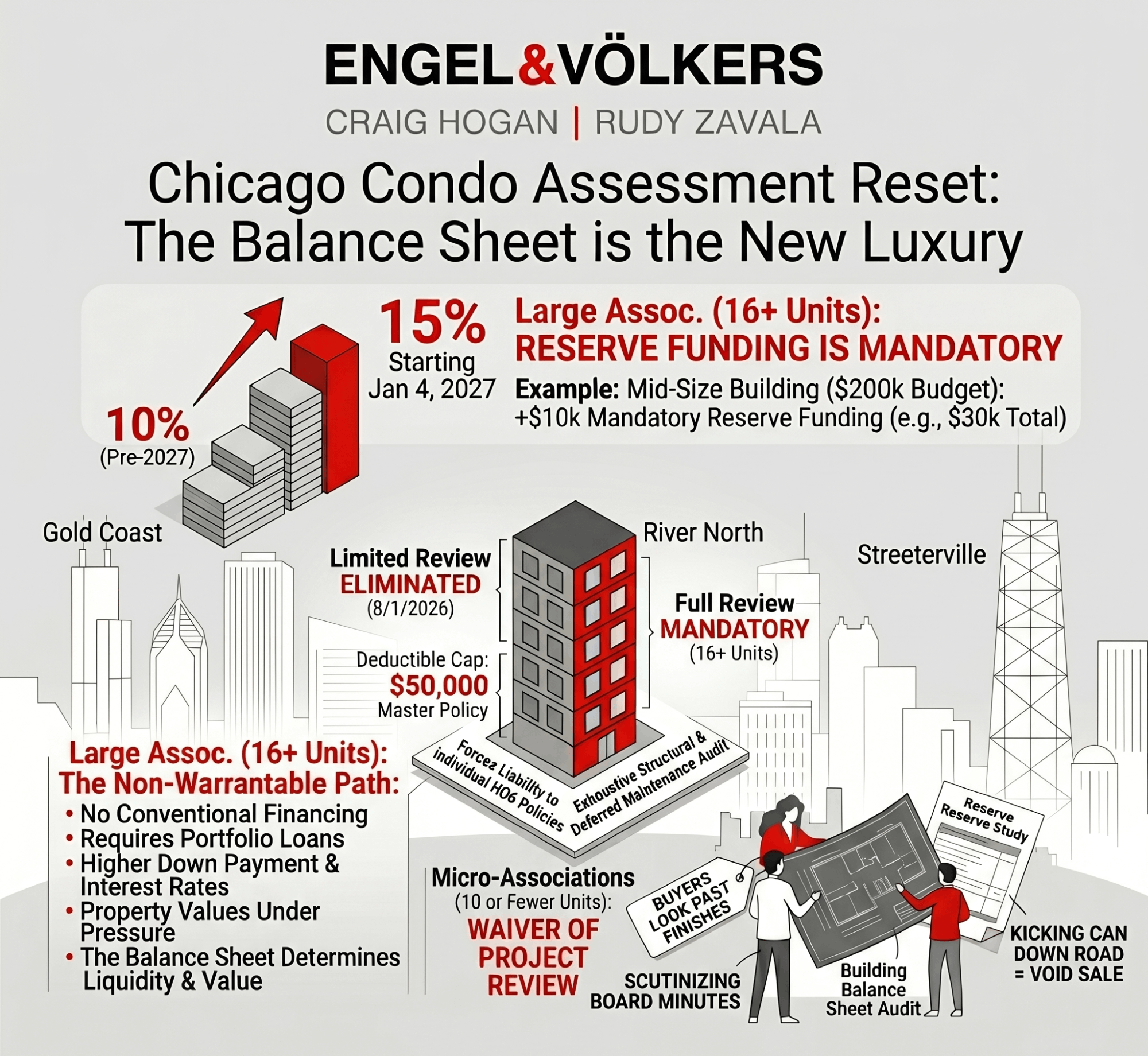
The immediate pressure point is two upcoming deadlines. Beginning August 1, 2026, Fannie Mae is eliminating the "Limited Review" option for all condominiums. Shortly thereafter, on January 4, 2027, the reserve baseline changes take effect. For any building that requires a Full Review, the minimum annual reserve budget allocation will increase from 10% to 15%. Consider the math on a mid-sized Chicago building with a standard $200,000 operating budget: the board must now slide at least $30,000 straight into reserves. This single line-item adjustment will force massive, immediate assessment hikes across the city. Combined with a rigid $50,000 per-unit deductible cap on master insurance policies—effectively shifting building liability directly onto individual HO6 policies—this has resulted in a skyrocketing administrative burden.
The view from the lender’s desk confirms that the friction in today's market is no longer just a negotiation between buyer and seller; it is a collision between a building’s history and an underwriter’s checklist. In analyzing the underwriting reality with Leslie Struthers at Rate, the overarching directive from the secondary market is clear. As Leslie puts it: "In essence, the Agencies want to ensure residents live in safe buildings with fiscally responsible Associations. While exceptions to these policies will still be allowed based on highly specific loan characteristics, the broader operational standards are non-negotiable."
Lenders are scrutinizing structural logs and deferred maintenance with unprecedented intensity, but the weight of this regulatory hammer hits our Chicago grid differently, based entirely on building size.
For micro-associations of ten or fewer units, there is a brief silver lining. Fannie Mae and Freddie Mac have extended their "Waiver of Project Review" to these smaller properties. If a buyer is looking at a classic six-unit vintage brick building in Lincoln Park or Wicker Park, the lender can bypass the most grueling portions of the standard condo questionnaire, maintaining transaction velocity. Move into the small-to-mid tier of 15 or fewer units, and the relief shifts to the state level. As Illinois legislative proposals like HB2563 push to mandate professional reserve studies every five years, these smaller associations are slated for an exemption, sparing them the immediate burden of heavy engineering fees.
The full weight of the new reality falls squarely on larger associations of 16 or more units. These properties face the strict 15% reserve baseline, exhaustive structural scrutiny, and the total sunset of Limited Reviews. If a building cannot clear these project standards, it falls into non-warrantable territory. For a buyer, conventional financing vanishes. They are forced into portfolio loans that require significantly higher down payments and premium interest rates. In high-density luxury pockets like River North, Streeterville, and the Gold Coast, this completely alters the trajectory of a sale.
In a mature vertical market, pricing has always been a function of strategy rather than optimism. Today, a building’s balance sheet is just as critical to its valuation as its architectural pedigree or its lake views. Modern buyers are highly educated, deeply data-driven, and perfectly comfortable walking away from a property if the board minutes show decades of kicked cans down the road.
For decades, some boards kept monthly assessments artificially low to appease vocal owners, treating reserve funds like an optional savings account.
An assessment is simply the cost of entry to premium vertical living. A higher monthly fee that guarantees compliance, flawless maintenance, and a robust reserve fund is no longer a marketing deterrent—it is the ultimate luxury asset because it preserves the asset's liquidity.
For sellers, the lesson is clear: you cannot effectively position a property in today’s market without an intimate, verified understanding of your association’s financial standing. Testing the market with a premium price tag while sitting on an underfunded reserve is a fast track to a stale listing. Beautiful finishes can always be replicated, but in this landscape, financial discipline is the one thing you cannot fake.
— Craig Hogan & Rudy Zavala
Hogan Zavala Group | Engel & Völkers Chicago
FOLLOW OUR YOUTUBE CHANNEL HERE
Details on the top 10 markets in Chicago are just a click away!
*This story is not meant to be any form of legal or financial advice.
Categories
- All Blogs (130)
- Adaptive Reuse (2)
- Architecturally Significant (23)
- Architecture (59)
- Art (2)
- Art Collecting (2)
- Bespoke Lighting (2)
- Buena Park (1)
- buyer strategy (30)
- Career Moves (9)
- chandeliers, (1)
- Chicago HOA Fees (7)
- Chicago Luxury Real Estate (94)
- Chicago Property Taxes (4)
- closet design (2)
- Co-Ownership (3)
- Coffee (1)
- Condo Assessments (7)
- coop apartments (5)
- cooperative apartments (8)
- custom closet advice (1)
- Days on Market (16)
- Design (51)
- Fulton Market District (8)
- Gold Coast (25)
- Golden Visa Programs (10)
- Historic Homes (8)
- Hogan Zavala Group (60)
- Holiday Abroad (1)
- International Citizenship (15)
- International Real Estate (31)
- Kitchen Design (13)
- Lakeview (14)
- Legacy (3)
- LGBTQ Housing (2)
- LGBTQ+ (4)
- Lifestyle (78)
- Lighting (2)
- Lincoln Park (14)
- Loft Living (5)
- Lofts (5)
- Logan Square (4)
- loneliness & aging (2)
- Loop (2)
- Luxury Market Index (4)
- Marina Towers (4)
- Market Insights (17)
- Market Update (36)
- Mid Century (2)
- New East Side (1)
- Outdoors (5)
- Pacaso Vacation Homes (3)
- pied-à-terre (15)
- Puerto Vallarta (8)
- Puerto Vallarta Real Estate (9)
- Real Estate Agents Success (11)
- Real Estate Industry (30)
- Real Estate Legal Changes (5)
- Real Estate Transactions (7)
- ritual (4)
- River North (21)
- River West (14)
- Second Homes (9)
- Seller Strategy (28)
- Selling and Buying in Chicago (34)
- Senior Housing (2)
- Streeterville (15)
- Summer (7)
- Sustainability (7)
- Taxes (5)
- Thanksgiving Travel (1)
- The 606 (1)
- The Henrys (1)
- Travel (1)
- Trends (29)
- Trifecta (17)
- Uptown (2)
- video (1)
- video for real estate (2)
- Wellness (9)
- West Loop (9)
- Wheaton (1)
- Wicker Park | Bucktown (4)
- Wines for Summer (2)
Recent Posts










Craig Hogan | Rudy Zavala