
Chicago Real Estate Market Update — March 2026: Demand Returns, Inventory Constrains
A Market Defined by Alignment, Not Urgency
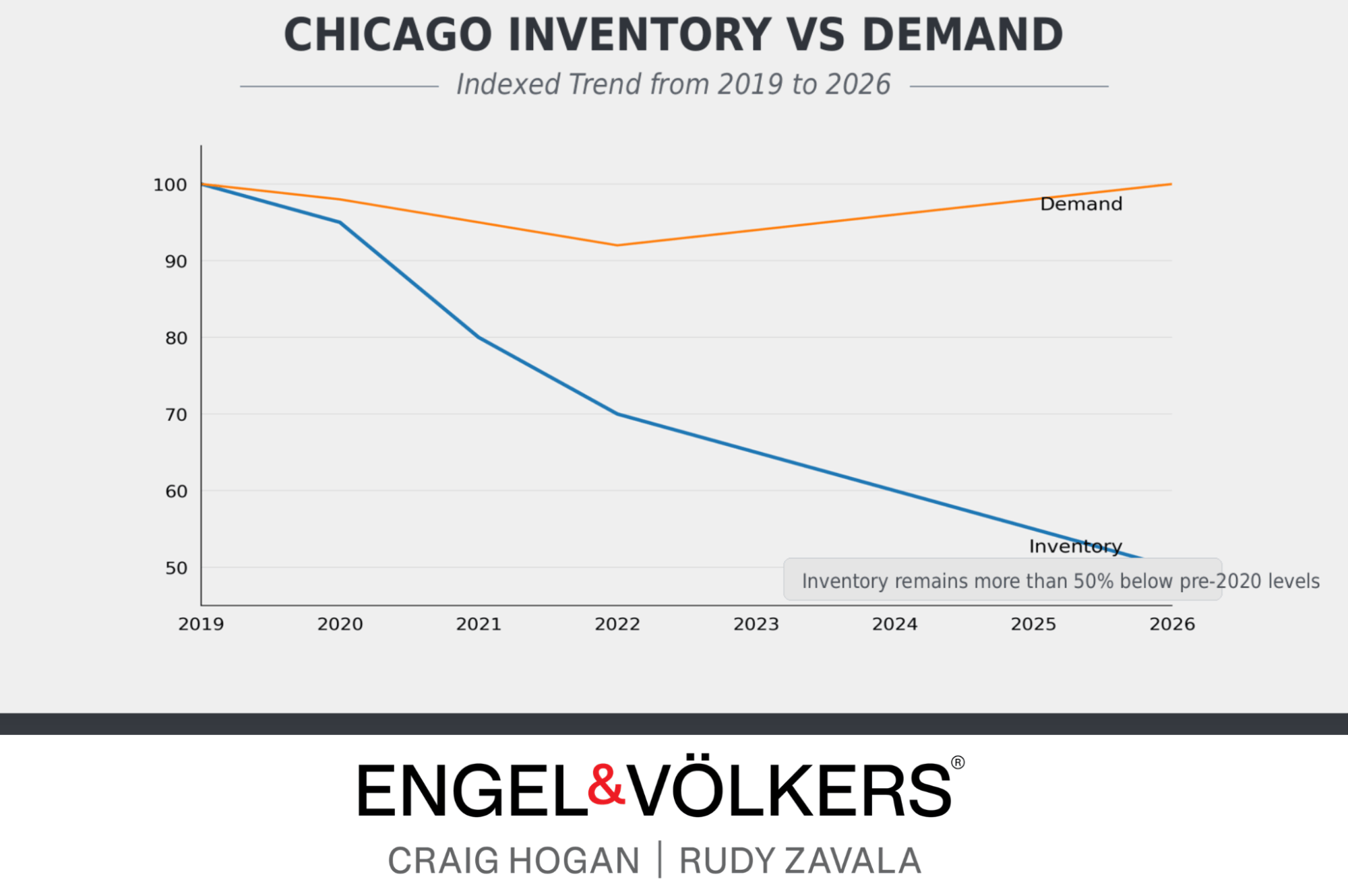
Demand has returned. Inventory hasn’t.

March didn’t ease its way into the year. It arrived with buyers already in motion, contracts following, and a level of consistency that had been missing through much of the winter. This wasn’t a surge or a spike. It was something more important—evidence that the market has re-engaged.
What’s becoming clear, however, is that demand is not the primary story. It’s the environment that demand is stepping into that defines this moment.
Inventory remains constrained in a way that is no longer temporary. New listings are coming online as expected for the season, but not at a pace that materially changes the supply picture. We are still operating well below pre-2020 levels, and that gap continues to shape how the market behaves.
The result is a market that feels active without feeling loose. Buyers are returning, but they are doing so into a landscape where choice is limited and decisions are being made more quickly when the right opportunity presents itself.
Chicago Is Finding Its Rhythm Again
Nationally, the narrative remains mixed. Some markets are still working through excess inventory, others are waiting for rate movement to unlock activity. Chicago, by contrast, is settling into a more stable pattern.
Absorption is steady. Inventory remains thin. And in several segments, homes are being absorbed faster than they are being replaced. It’s not uniform across every price point or neighborhood, but it is consistent enough to matter.
This is not a market accelerating out of control. It is a market regaining its footing, one transaction at a time.
Luxury Activity Is Expanding Beyond Its Core
The high end of the market offered a clearer signal in March.
Seven properties closed above $5 million across the region, a noticeable increase from the earlier months of the year. More important than the number itself is where those sales occurred. Activity spanned the lakefront, the North Shore, the western suburbs, and within the city, including a record-setting sale in Lakeview.
That distribution tells a more meaningful story than any single transaction. Demand at the upper end is no longer confined to the traditional luxury corridors. It is expanding outward, following quality product rather than simply established geography.
Buyers operating at this level tend to move with intention. When they begin transacting across multiple submarkets at once, it reflects confidence in value over time rather than short-term conditions.
The market is not moving evenly. It is rewarding alignment and exposing everything else.
A Benchmark Worth Remembering
Looking back one year, our sale on East Cedar Street in February of 2025—just over $4 million—remains a useful reference point for how this segment behaves when everything aligns.
It was not simply a function of price. It was a function of execution and positioning. The property was complete in its presentation, clear in its value, and it met a buyer who recognized both.
That dynamic has not changed. If anything, it has become more pronounced.
In today’s market, alignment between product and pricing is not a competitive advantage. It is the baseline requirement.
The Gold Coast Remains a Study in Contrast
The broader trends become more nuanced when viewed through the lens of the Gold Coast.
This has never been a single market, and it isn’t one now. What continues to emerge are two parallel tracks operating in parallel.
In vintage buildings and cooperatives, buyers are approaching decisions with a greater level of scrutiny. Monthly assessments, ownership structure, and long-term financial considerations are all part of the evaluation. These properties are trading, but they require precision in both pricing and expectation.
At the same time, renovated and turnkey residences are seeing a more immediate response. When the work has been done and the offering aligns with what today’s buyer expects, the market responds without hesitation.
The distinction is not subtle, and it is not new. What has changed is how clearly it is being expressed in real time.
Pricing Has Stabilized—But It Is Not Flexible
Pricing across the market has settled into a more disciplined range. The volatility of the past several years has given way to something more measured.
Within that stability, however, the margin for error has narrowed. Properties that are positioned correctly are moving with relative efficiency. Those that are not are being left to adjust, often over longer periods than anticipated.
This is where the gap in outcomes becomes most visible.
Time Continues to Tell the Story
Days on market have shortened in a way that reflects renewed engagement rather than urgency. Buyers are informed and deliberate, but when a property meets their criteria, they are prepared to act.
The absence of hesitation in those moments is one of the clearest indicators of where the market stands today.
Rates Are Part of the Picture—Not the Driver
Mortgage rates, still hovering just above six percent, remain a consideration but no longer dominate the conversation. Over time, buyers have adjusted to this range, and the expectation of significantly lower rates in the near term has largely faded.
As a result, decision-making has shifted away from waiting and toward acting within current conditions.
The Bottom Line
This spring is not defined by urgency or excess. It is defined by alignment.
Buyers understand what they are looking for. Sellers are being tested on whether they are willing to meet the market where it is. And the transactions that are occurring are the ones where those two sides come together without friction.
What sits outside of that alignment is not moving at the same pace.
And that, more than anything, is what defines the Chicago market as we move through March of 2026.
— Craig Hogan & Rudy Zavala
Hogan Zavala Group | Engel & Völkers Chicago
FOLLOW OUR YOUTUBE CHANNEL HERE
Details on the top 10 markets in Chicago are just a click away!
Categories
- All Blogs (130)
- Adaptive Reuse (2)
- Architecturally Significant (23)
- Architecture (59)
- Art (2)
- Art Collecting (2)
- Bespoke Lighting (2)
- Buena Park (1)
- buyer strategy (30)
- Career Moves (9)
- chandeliers, (1)
- Chicago HOA Fees (7)
- Chicago Luxury Real Estate (94)
- Chicago Property Taxes (4)
- closet design (2)
- Co-Ownership (3)
- Coffee (1)
- Condo Assessments (7)
- coop apartments (5)
- cooperative apartments (8)
- custom closet advice (1)
- Days on Market (16)
- Design (51)
- Fulton Market District (8)
- Gold Coast (25)
- Golden Visa Programs (10)
- Historic Homes (8)
- Hogan Zavala Group (60)
- Holiday Abroad (1)
- International Citizenship (15)
- International Real Estate (31)
- Kitchen Design (13)
- Lakeview (14)
- Legacy (3)
- LGBTQ Housing (2)
- LGBTQ+ (4)
- Lifestyle (78)
- Lighting (2)
- Lincoln Park (14)
- Loft Living (5)
- Lofts (5)
- Logan Square (4)
- loneliness & aging (2)
- Loop (2)
- Luxury Market Index (4)
- Marina Towers (4)
- Market Insights (17)
- Market Update (36)
- Mid Century (2)
- New East Side (1)
- Outdoors (5)
- Pacaso Vacation Homes (3)
- pied-à-terre (15)
- Puerto Vallarta (8)
- Puerto Vallarta Real Estate (9)
- Real Estate Agents Success (11)
- Real Estate Industry (30)
- Real Estate Legal Changes (5)
- Real Estate Transactions (7)
- ritual (4)
- River North (21)
- River West (14)
- Second Homes (9)
- Seller Strategy (28)
- Selling and Buying in Chicago (34)
- Senior Housing (2)
- Streeterville (15)
- Summer (7)
- Sustainability (7)
- Taxes (5)
- Thanksgiving Travel (1)
- The 606 (1)
- The Henrys (1)
- Travel (1)
- Trends (29)
- Trifecta (17)
- Uptown (2)
- video (1)
- video for real estate (2)
- Wellness (9)
- West Loop (9)
- Wheaton (1)
- Wicker Park | Bucktown (4)
- Wines for Summer (2)
Recent Posts








Craig Hogan | Rudy Zavala